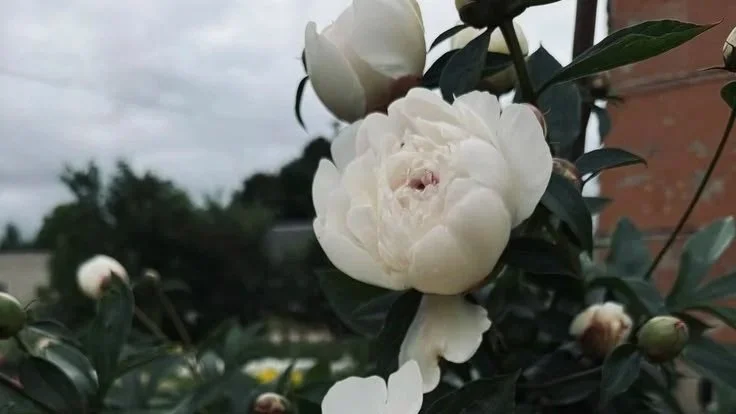
White peony, the physician of the gods
MATERIA MEDICA · No. 01 · 9 min read
A lavish, many-layered flower over a dense white root. In Chinese medicine, one of the great blood tonics, for the one who holds everything so tightly it has begun to cramp.
BOTANICAL NAME FAMILY
Paeonia lactiflora Paeoniaceae
PART USED TASTE AND TEMPERATURE
Root, peeled and cooked (bai shao) Bitter, sour · slightly cold
ENDOBIOGENY RESEARCH
Gonadotropic axis · antispasmodic Root extract (TGP) trialled for immune balance, mostly in China
ARCHETYPE TRADITION
The physician of the gods Chinese medicine · blood tonic
THE RESEARCH LENS
What science has looked at
The root's main compound is paeoniflorin, a glycoside studied in the laboratory for its effects on muscle tone, inflammation and the nervous system. Small clinical studies, many from Japan, have looked at the peony and licorice pairing for muscle cramps and for hormone patterns in the menstrual cycle.
The most studied preparation is total glucosides of paeony (TGP), an extract of the root approved as a medicine in China. Trials there, many adding TGP to standard medicines, have looked at rheumatoid arthritis, Sjögren's syndrome, lupus and psoriasis, and meta-analyses report modest improvements, with the clearest benefit being fewer liver side effects from the standard medicines.
For the cycle, the best-known studies are Japanese, on the peony and licorice formula Shakuyaku-kanzo-to. In a 1988 study of 20 women with PCOS who were trying to conceive, testosterone fell in 18 of them and 5 became pregnant, with results varying by the pattern of the ovaries on ultrasound. Laboratory work published in 1991 suggested paeoniflorin and licorice compounds reduce androgen production in ovarian cells. The studies are small and uncontrolled, and licorice can raise blood pressure and lower potassium, so the pairing is always prescribed with monitoring.
In the laboratory, paeoniflorin is being studied for how it shifts the balance between inflammatory immune cells and regulatory ones, the cells that keep the immune system tolerant of the body's own tissues. The trials come mostly from one country and vary in quality, so this is promising rather than settled. Outside these extracts, most human research is on formulas rather than peony alone.
THE ENDOBIOGENY LENS
Reading it through the endocrine system
Endobiogeny reads a plant by how it acts on the endocrine and autonomic systems. White peony is considered for the gonadotropic axis, the line from brain to ovaries, particularly where androgens run high relative to oestrogen and progesterone.
Its antispasmodic action is read as easing cramping where sympathetic tone, the body's push and grip, is running high. Routine blood tests, read through the Biology of Functions, guide whether it belongs in a formula.
The pattern that brings peony to mind is a genital ratio leaning towards androgens, with oestrogen poorly expressed in the tissues, alongside an LH-driven picture on the gonadotropic axis: the pattern often seen in PCOS. Where alpha-sympathetic tone is also high, the cramping and tension that go with it make it a closer fit. Where oestrogen activity already dominates and androgens are low, peony is not the first choice.
CLINICAL WISDOM
How I work with it
White peony is considered where tension and depletion meet: irritability and cramping alongside tiredness and thin blood. It is almost always used within a formula, often with Rehmannia or licorice, chosen for the whole picture.
In autoimmune and inflammatory conditions, I consider white peony where inflammation and tension sit together, always within a formula, alongside the person's specialist and current medicines, and with the gut, stress load and nutrient status addressed at the same time. The aim is immune tolerance: a calmer, better-regulated response, not a suppressed one.
TRADITIONAL WISDOM
The heart of the women's formulas
Bai shao sits with Rehmannia in Si Wu Tang, the Four Substances, the classical formula for nourishing blood. It is central to Xiao Yao San, the Free and Easy Wanderer, traditionally used where tension, irritability and a tired, depleted body meet. Paired with licorice in Shao Yao Gan Cao Tang, it is the classical remedy for cramping.
In Greek myth, the peony is named for Paeon, physician to the gods, who healed Hades with its root. When his teacher Asclepius grew jealous, Zeus saved Paeon by turning him into the flower.
ENERGETICS
Bitter, sour, slightly cool
In Chinese medicine, bai shao is bitter, sour and slightly cold, and enters the liver and spleen. It is traditionally used to nourish the blood, to soften and calm the liver, to ease cramping, and to hold in the yin, which is why it is used where sweat and fluids are being lost.
White peony and red peony, chi shao, come from the same plant. White is peeled and nourishes. Red is unpeeled and is traditionally used to move and cool the blood. Mu dan pi, in the Rehmannia formula, is a different plant again: the bark of the tree peony.
THE ANTHROPOSOPHICAL LENS
Where the soul grips too tightly
Anthroposophic medicine reads a plant as a mirror of the human being: the root speaks to the nerves and senses, the leaf to the rhythm of breath and circulation, the flower and fruit to metabolism and warmth.
It reads cramping as the soul, the astral body, gripping too tightly into the body. Peony holds an overflowing flower over a dense, sour root: abundance kept in form. One reading is a plant that helps the soul hold the body without clenching, so rhythm can return where spasm has taken over.
THE SIGNATURE
Softness with a spine
White peony is the composed one: gracious, unhurried, softening without giving way. A lavish, many-layered flower over a dense white root, it holds abundance in form. Its affinity is for the liver, the blood and the smooth muscle of the womb and gut; its quality is cool, sour and gathering. It meets the person holding everything so tightly it has begun to cramp.
The flower opens for a short season in late spring, yet the plant can bloom in the same place for a century, and it dislikes being moved. The root is peeled to its white core, and its taste is sour, the taste that gathers and holds in. Across every tradition that knows it, peony is read the same way: it loosens the grip without letting go.
THE ARCHETYPAL LENS
The healer who holds it together
In the archetypal lens, a plant is read through the myths and images people have attached to it, the way Jungian psychology reads recurring figures in stories and dreams. Peony carries the archetype of the physician: Paeon, the healer of the gods, who tended even Hades with its root. When his teacher grew jealous, he was saved by being turned into the flower itself.
It is the image of the composed caregiver, the one everyone leans on. The gift of this archetype is grace under pressure. Its shadow is control: holding every edge so tightly that the healer forgets to soften for themselves. Peony's invitation is to keep the composure and let go of the grip.
THE TEACHING
The lesson it carries
Peony's lesson is that holding on and holding together are not the same thing. In the body, it is traditionally used to nourish blood, ease cramping and steady the cycle. In the mind, the clench in the jaw and the edge in the voice begin to soften. The question it leaves: what are you holding so tightly that it has begun to cramp?
CAUTIONS
Before you meet it
Use in pregnancy only under a qualified practitioner. It may affect blood clotting, so seek advice if you take blood-thinning medicines or are having surgery. When paired with licorice, blood pressure and potassium need watching. In Chinese medicine it is used with care where digestion is cold and stools are loose. In autoimmune conditions, use it only with a practitioner who knows your medicines. Loose stools are the most common side effect of the extract.